

Original price was: ₹25,500.00.₹19,800.00Current price is: ₹19,800.00.
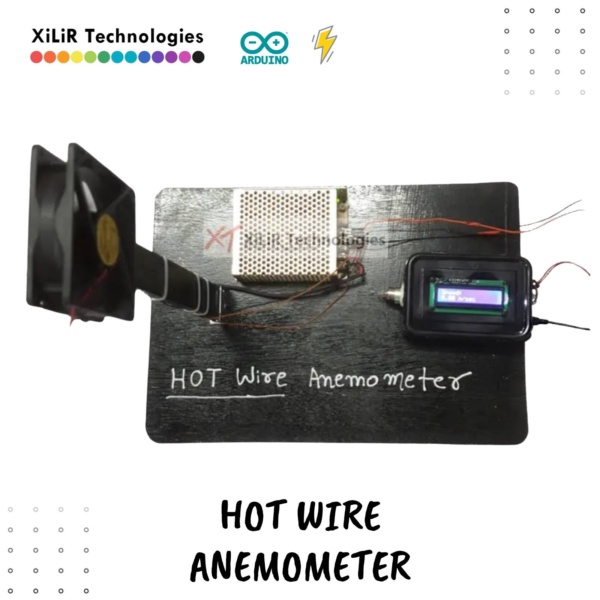
Accurate and reliable wind speed measurement is crucial for various applications, including weather forecasting, renewable energy assessment, and environmental monitoring. This project presents a novel approach to measure wind speed using a combination of a fan, hot filament, and voltage divider circuit.
✨ Highlights
📏 High Sensitivity Wind Speed Detection
🔥 Heat Dissipation Based Measurement
⚡ Voltage Divider Signal Conditioning
📟 16×2 LCD Live Wind Speed Display
📺 YouTube Video : Watch Project Video
📘 Introduction
Accurate wind speed measurement plays a vital role in meteorology, renewable energy systems, environmental monitoring, and industrial safety applications. Traditionally, wind speed has been measured using mechanical cup anemometers or vane-based systems. However, with advancements in sensor technology and embedded systems, electronic methods such as hot wire anemometry have become increasingly popular due to their high sensitivity and fast response time.
The Hot Wire Anemometer using Arduino is an innovative wind speed measurement system based on the principle of heat transfer. In this method, a hot filament (hot wire) is heated electrically, and the cooling effect caused by airflow changes its temperature and resistance. This variation in resistance is converted into a measurable voltage signal using a voltage divider circuit. The Arduino microcontroller processes this signal and calculates the corresponding wind speed. The measured value is then displayed on an LCD screen for real-time monitoring.
This project combines heat transfer principles, electronic signal processing, and embedded programming to create a cost-effective and reliable digital wind speed measurement system suitable for educational and practical applications.
🎯 Objectives
To design and develop a hot wire based wind speed measurement system.
To measure wind speed using heat dissipation principle.
To implement a voltage divider circuit for resistance-to-voltage conversion.
To process sensor data using an Arduino microcontroller.
To display real-time wind speed values on an LCD display.
To create a low-cost and reliable alternative to conventional anemometers.
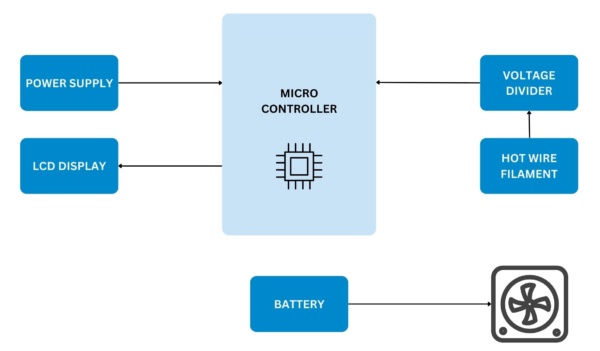
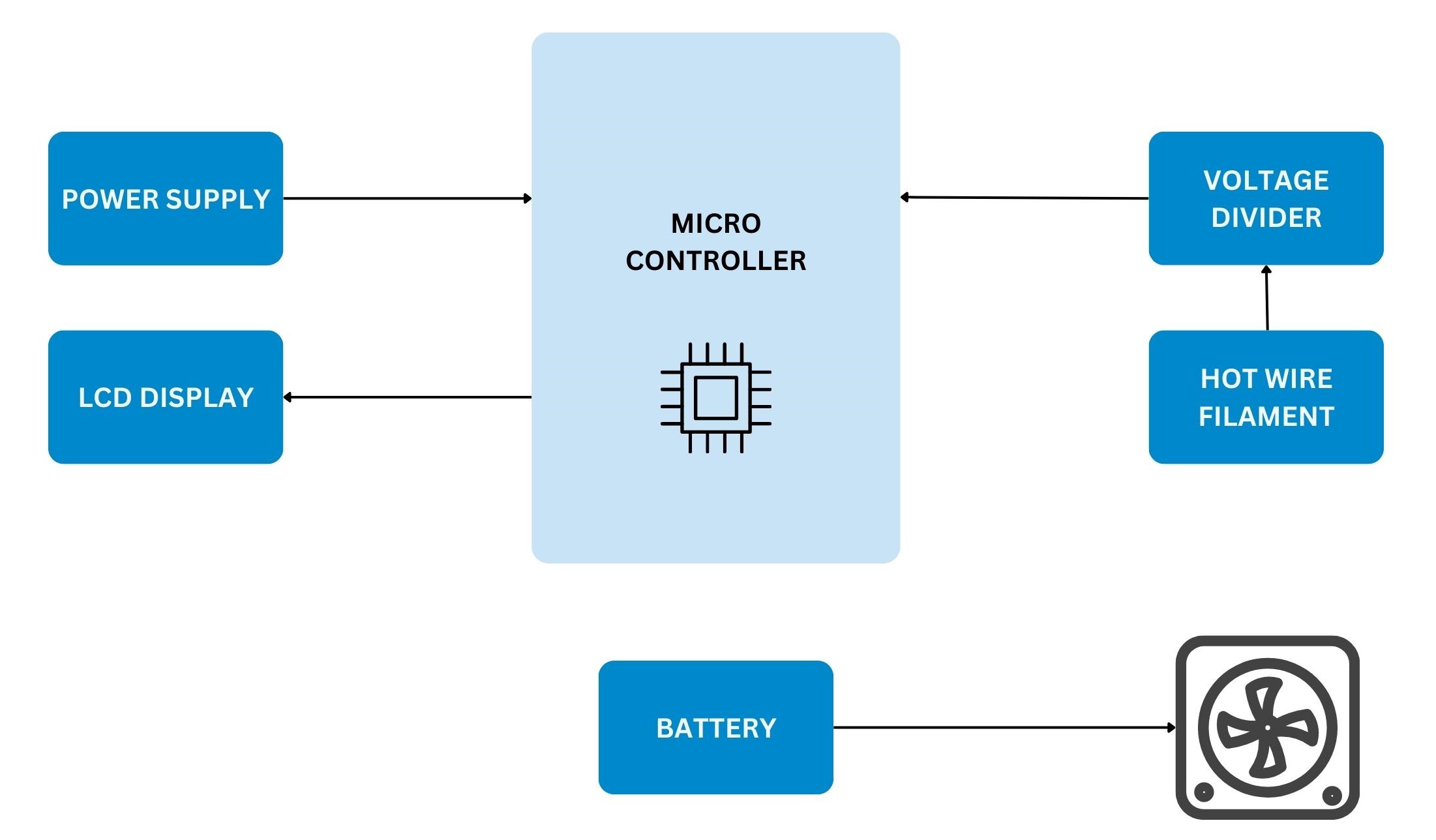
BLOCK DIAGRAM
HARDWARE COMPONENT
💻 Software Requirements
📘 Methodology
The methodology of the Hot Wire Anemometer using Arduino begins with heating a thin filament wire using a controlled power supply. When air flows across the heated filament, it cools the wire, causing a change in its resistance. This resistance variation is converted into a voltage signal using a voltage divider circuit. The output voltage is fed into the analog input of the Arduino microcontroller. The Arduino processes the analog data, converts it into digital values, and calculates wind speed based on calibrated equations. The calculated wind speed is displayed on an LCD display for real-time monitoring. The system is powered using a regulated power supply to ensure stable operation. Finally, the setup is tested using a DC fan to simulate airflow conditions and validate the accuracy and responsiveness of the system.
Students can enhance or modify this project based on college syllabus, guide instructions, or personal interest.
Customizations help improve innovation, marks, and practical understanding.
Available Customization Options:
🌐 IoT/ AI/ ML Integration ( ThingSpeak, Blynk, Firebase, Web Dashboard etc. )
☀️ Solar Power Integration
🤖 Machine Learning / AI Modules
📡 GPS & GSM Based Tracking / Alerts
📟 Additional Sensors (as per application)
📲 Mobile App / Web Monitoring
📊 Advanced Data Logging & Graphs
⚙️ Hardware & Software Feature Modifications
🎯 Customization as per College or Guide Requirement
If you need any additional feature or modification,
📞 Contact us on WhatsApp and share your requirement.

Early Project Booking Recommended
Early Project Booking – Strongly Recommended
Students are advised to book their final year or semester project early, even with just a title or brief idea. Early booking helps us reserve your preferred topic, start documentation, diagrams, code planning, and component preparation in advance, and provide timely academic guidance.
You will receive complete documentation (abstract, report, block diagram, circuit, code explanation) well before submission. The working hardware kit will be delivered as per your college schedule. PPTs for reviews, viva, or seminars will be prepared on request.
Book early → Stay stress-free → Focus on learning.
Contact us with just the project title—we’ll handle the rest.


Reviews
There are no reviews yet.