



Original price was: ₹18,000.00.₹11,990.00Current price is: ₹11,990.00.
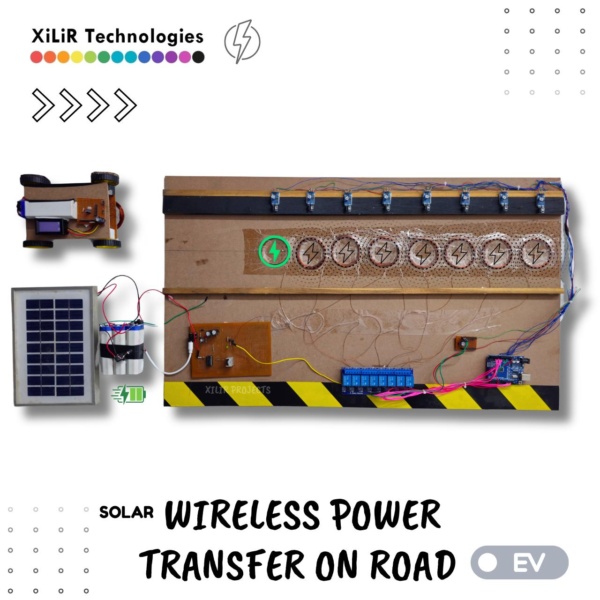
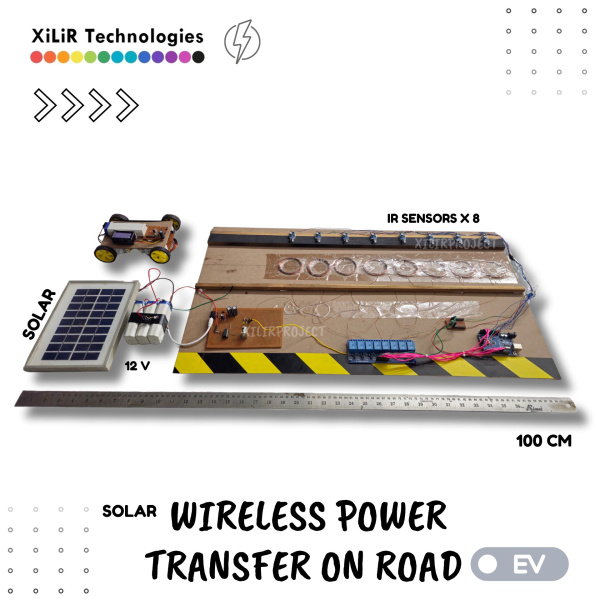
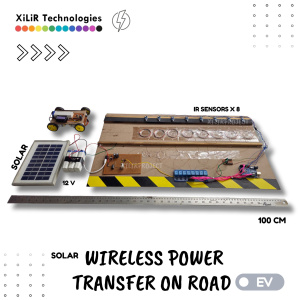
The project demonstrates dynamic inductive charging using 8 coils embedded in the road, triggered by IR sensors, and controlled by a single Arduino. Power pulses are generated using the CD4047 pulse generator and Z540 MOSFET, allowing real-time, contactless battery charging as the car moves.
Key Features:
🔋 Wireless power transfer for EVs
🛣️ Smart road embedded with coils
⚡ Contactless charging while moving
📈 Educational, practical
📺 YouTube Video :
Project short : New Version, this one you will get when you order
#WirelessPowerTransfer #EVChargingSystem #ArduinoProjects #SmartRoadTechnology
#DynamicEVCharging #ElectromagneticInduction #EngineeringProjects

#MajorProjectIdeas #CD4047PulseGenerator #EmbeddedSystemsProject
#RoadEmbeddedCharging #EVPrototype #TechExhibitionModel
This is Award-Winning Project you can select this as your major project, capstone project, competition, exhibition projects etc. (Highly Recommended)
📘Introduction:
The rapid worldwide shift to electric cars (EVs) must be accompanied by intelligent, efficient, and user-friendly charging technologies to replace conventional plug-in technology. Wireless Power Transfer (WPT) is among the most promising technologies to do so, which is contactless transfer of electrical energy by electromagnetic induction. In this work, a functional prototype of dynamic wireless charging is proposed, where an EV is charged wirelessly during travel, without physical contacts, human intervention, and stationary charging stops.
These wireless charging technologies have the potential to significantly boost the convenience, safety, and efficiency of EV infrastructure. As of 2022, the global EV fleet exceeded 26 million vehicles and is likely to surpass 140 million by 2030, the International Energy Agency (IEA) states. Range anxiety and charging time are still major obstacles, though. By allowing in-motion charging, the proposed solution obviates these obstacles, which enable prolonged operation of public transport, freight trucks, and autonomous fleets without frequent stops or massive battery capacity. Besides, this technology can be integrated with solar energy-based pulse generation to help with green mobility and sustainable transport missions.
The structure includes a single Arduino UNO microcontroller driving 8 copper transmitter coils, driven by an 8-channel relay module and IR sensors. With the EV driving along a pre-programmed road path embedded with the coils, it turns on the IR sensors, which in turn switch on the Arduino to drive the respective coil by a pulse generator. The coil creates a magnetic field which induces current in the receiver coil mounted on the EV, which is utilized to charge the onboard battery in real time. A voltmeter mounted on the EV displays the induced voltage, and hence the charging process is visible.
Block Diagram
Component Required:
1. Transmitter Side (Road Setup)
• Arduino UNO: Acts as the control unit that monitors all 8 IR sensors and activates the corresponding relay channel.
• IR Sensors (×8): Detect the presence of the EV car above each coil and send a signal to the Arduino.
• 8-Channel Relay Module: Used to switch each of the 8 transmitter coils ON/OFF sequentially.
• CD4047 IC: A monostable/astable multivibrator IC configured here to generate continuous square wave pulses (AC signal) to drive the coils via the MOSFET.
• Z540 MOSFET: Acts as a switching device to amplify and deliver the pulsed current from CD4047 to the transmitter coil.
• Copper Coils (45 turns ×8): Serve as the transmitting coils embedded under the road to generate the magnetic field.
• Power Supply (12V DC): Powers the entire road setup, including Arduino, relay module, and pulse generator.
• Solar Panel : for Charging Batteries
2. Receiver Side (EV Car)
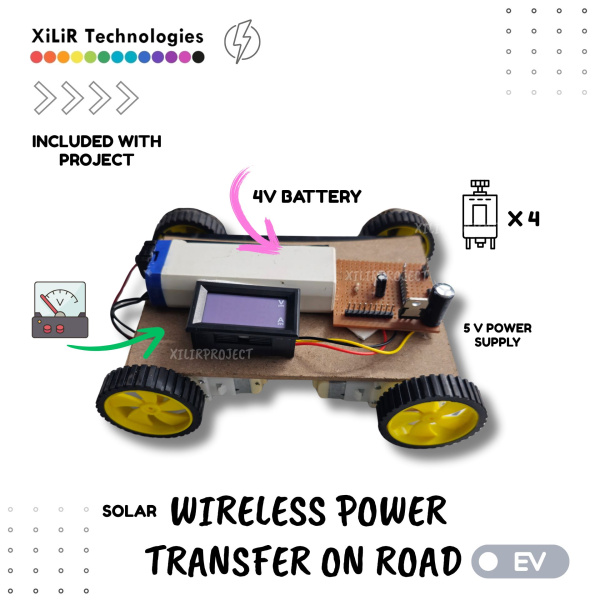
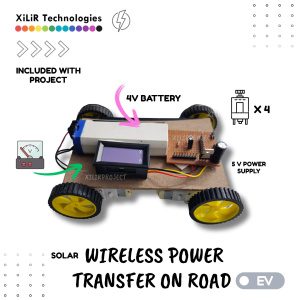
• Copper Coil (125 turns): Acts as the receiver coil placed at the bottom of the EV to capture the magnetic flux.
• 8V Battery: Stores the induced energy and powers the four DC motors of the EV car.
• DC Motors (4V ×4): Enable motion of the EV car as it moves across the embedded coils.
• Voltmeter: Displays the real-time voltage induced in the receiver coil during motion.
• Chassis/Wheels: Mechanical frame and components for movement and structural support.
Working Principle:
Once powered, the Arduino begins executing its logic to monitor all IR sensors. When the EV aligns with a particular road coil, the corresponding IR sensor detects the presence of the car and sends a signal to the Arduino. The Arduino then activates the matched relay, completing the circuit between the pulse generator and that specific coil. The energized coil emits a magnetic field that induces voltage in the vehicle’s receiver coil. This voltage is routed directly to the EV’s battery and can be observed using the onboard voltmeter.
As the EV continues moving, it triggers the next IR sensor, and the Arduino activates the next coil while deactivating the previous one. This sequential activation allows for consistent and smooth wireless charging along the motion path. The battery gets recharged incrementally without any wire contact or manual intervention.
Theory of Operation –🔋 Wireless Power Transfer via Inductive Coupling
1. Electromagnetic Induction Basics
When an alternating current flows through the transmitter coil, it generates a time-varying magnetic field. If a secondary coil (receiver coil) is placed within the magnetic field, a voltage is induced across it. This phenomenon is governed by Faraday’s Law of Electromagnetic Induction:
ε = -N × dΦ/dt
Where:
ε = Induced EMF (in volts)
N = Number of turns in the receiver coil
Φ = Magnetic flux through a single loop
dΦ/dt = Rate of change of magnetic flux
2. Magnetic Flux and Coupling
The magnetic flux Φ through the receiver coil is proportional to the magnetic field B generated by the transmitter coil and the effective area A of the receiver coil:
Φ = B × A × cos(θ)
Where:
B = Magnetic field strength
A = Area of the receiver coil
θ = Angle between the magnetic field and normal to the coil (ideally 0° for max flux)
The efficiency of transfer is determined by the coupling coefficient k, which depends on the alignment and distance between coils. The power transferred P can be approximated using mutual inductance M:
P = ω × M × I₁ × I₂
Where:
ω = Angular frequency of current (2πf)
M = Mutual inductance between coils
I₁, I₂ = Currents in transmitter and receiver coils respectively
Application to the Project
Transmitter Coil (Road Side): Each coil is excited by a pulse generator (AC source) when triggered by the corresponding IR sensor. These coils have 45 turns, generating a time-varying magnetic field under the car.
Relay Control: An 8-channel relay driven by the Arduino UNO ensures that only one coil is active at any time, based on which IR sensor is triggered. This sequential activation saves energy and avoids magnetic interference.
Receiver Coil (On EV): The car has a 125-turn receiver coil, which passes over each active transmitter coil. The coil picks up the changing magnetic field and induces a voltage based on the above principles. The voltage is monitored by a voltmeter and directly used to charge the battery or drive the DC motors.
Power Output Estimation (Simplified): Assuming an average induced voltage of V_ind ≈ 6.5 V and current I ≈ 0.5 A, the received power is:
P = V_ind × I = 6.5 × 0.5 = 3.25 W
🚗 more Titles suggestions for this project :
Arduino-Controlled Road-Embedded Wireless Charging for EVs
Electromagnetic Induction-Based Dynamic EV Charging System
Design and Implementation of Coil-Based Wireless Power Transfer for Moving Vehicles
Solar-Powered Contactless Charging System for Electric Cars
Sequential Coil Activation for Wireless EV Battery Charging using IR and Arduino
Low-Cost Wireless Charging Lane Prototype for Electric Vehicles
Real-Time Wireless Charging Demonstration Using Pulse Generator and MOSFET Control
Dynamic Wireless Energy Transfer to EVs using IR Sensor-Triggered Coils
Embedded Coil-Based Smart Road for Autonomous EV Charging
Prototype of Magnetic Field-Based EV Charger Using CD4047 and Z540 MOSFET
Smart Transportation Model — Simulates future smart roads with embedded wireless charging zones.
Practical Demonstration of Inductive Power Transfer — Explains Faraday’s Law and mutual inductance with real hardware.
Ideal for Exhibitions — Moving EV prototype visually shows how IR sensors trigger road coils to power the car.
Wireless power transfer for electric vehicles, Arduino based EV charging project, road embedded EV charger, dynamic EV charging system, contactless EV charger using Arduino, CD4047 pulse generator project, Z540 MOSFET switching circuit, inductive charging system for electric vehicles, IR sensor based EV charging, M.Tech major project on EV, engineering exhibition EV project, smart road wireless charging, renewable energy EV project, coil based energy transfer system, real-time EV battery charging model, wireless power transfer for EV, Arduino EV charging project, inductive EV charger, road embedded charger, CD4047 based WPT, MOSFET powered EV charger, smart transport EV model, electric vehicle project for MTech students.
========================
👉🚀 Don’t forget to SUBSCRIBE for more Science/ Diploma/ Engineering Projects !
========================
Get the full working project with components, code, diagrams & explanation
No branding on project, handmade look for students, and different styles as required by students.
To Buy/ Make this project with training
Contact us:
👨🏼🏭Dr. Vipin Kumar Sharma
Ph.D., M.Tech, B.Tech in ECE
🎓Lecturer 🚀#Researcher #Drone #Robotics
WhatsApp : https://wa.me/919810326343
Hindi/ English
✅🔥Follow us on
▶️YouTube 👥 Facebook 🐤 Twitter 📸 Instagram👨🏻🎓 LinkedIn
𝗔𝗯𝗼𝘂𝘁 𝗨𝘀 :
𝗫𝗶𝗟𝗶𝗥 𝗧𝗲𝗰𝗵𝗻𝗼𝗹𝗼𝗴𝗶𝗲𝘀™ is India’s 🔖Top rated & Leading R&D Company. It’s an ISO 9001:2008 Certified Company & Govt Approved under MCA & it was established in 2012.
Students can enhance or modify this project based on college syllabus, guide instructions, or personal interest.
Customizations help improve innovation, marks, and practical understanding.
Available Customization Options:
🌐 IoT/ AI/ ML Integration ( ThingSpeak, Blynk, Firebase, Web Dashboard etc. )
☀️ Solar Power Integration
🤖 Machine Learning / AI Modules
📡 GPS & GSM Based Tracking / Alerts
📟 Additional Sensors (as per application)
📲 Mobile App / Web Monitoring
📊 Advanced Data Logging & Graphs
⚙️ Hardware & Software Feature Modifications
🎯 Customization as per College or Guide Requirement
If you need any additional feature or modification,
📞 Contact us on WhatsApp and share your requirement.

Early Project Booking Recommended
Early Project Booking – Strongly Recommended
Students are advised to book their final year or semester project early, even with just a title or brief idea. Early booking helps us reserve your preferred topic, start documentation, diagrams, code planning, and component preparation in advance, and provide timely academic guidance.
You will receive complete documentation (abstract, report, block diagram, circuit, code explanation) well before submission. The working hardware kit will be delivered as per your college schedule. PPTs for reviews, viva, or seminars will be prepared on request.
Book early → Stay stress-free → Focus on learning.
Contact us with just the project title—we’ll handle the rest.
No branding, handmade and different look as required by students.
WhatsApp : https://wa.me/919810326343
————————————
🔖 What you’ll get when you order this Project !
💯 Fully Assembled & Working Project.
🛠️ The project can be disassembled and reassembled if needed, making it easier to show progress-wise demonstrations to your guide.
📘 Includes Synopsis, Report, PPT & more.
📊 Block Diagram & Circuit Diagram – With explanations.
📦 Component Specs List.
⚙️ Working Principle Explained.
📑 Datasheets of All Components.
💻 Arduino Code + Training.
🧾 Bill of Materials (BOM) – Every item listed.
🔌 Complete Interfacing Guide – Learn how each part is connected.
🚚 Cash on Delivery Available – Safe & Secure delivery.
🎓 Viva Q&A Guidance – Be 100% ready for your Viva.
❓Need anything, Just ask us – we’re here to help! 🙌
————————————
🥇 Trusted by 20,50,000+ Students / Teachers & Innovators.
Additional Services you can buy :
Research paper, Review paper,
Plagiarism free Report with Turnitin report,
internship, industrial training/ project etc.





Reviews
There are no reviews yet.