

Original price was: ₹8,500.00.₹6,490.00Current price is: ₹6,490.00.
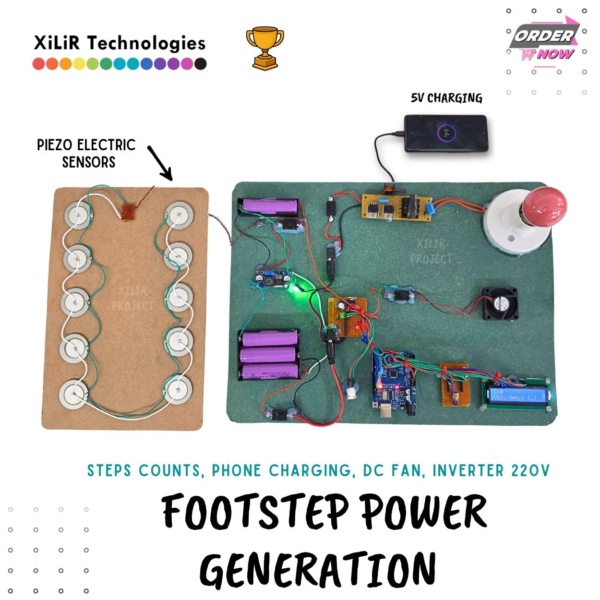
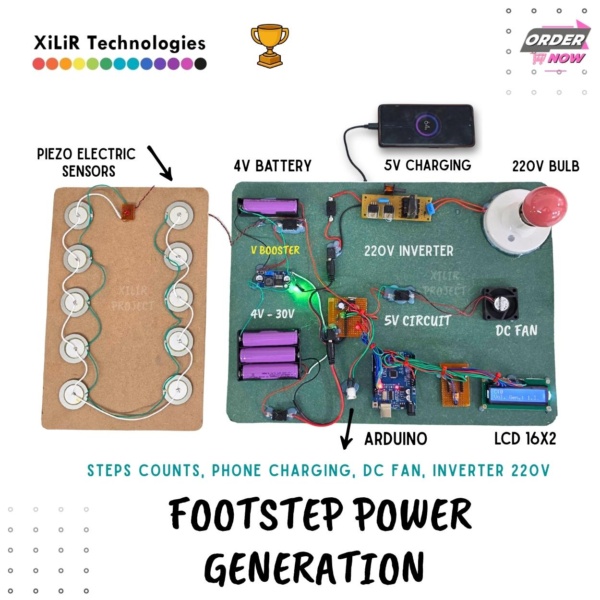
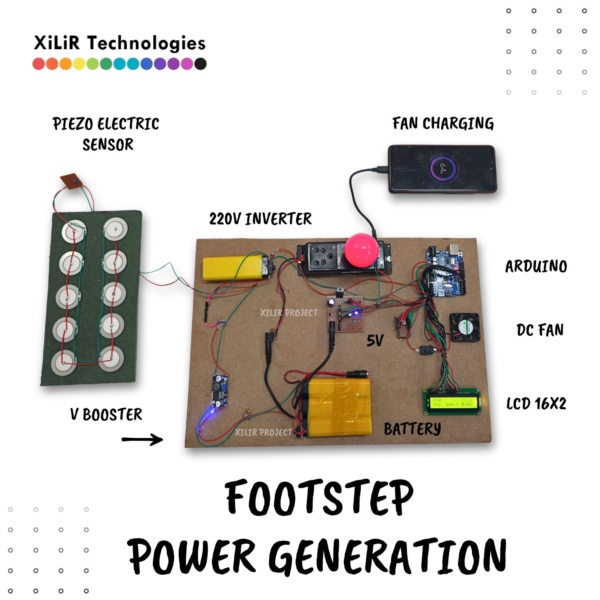
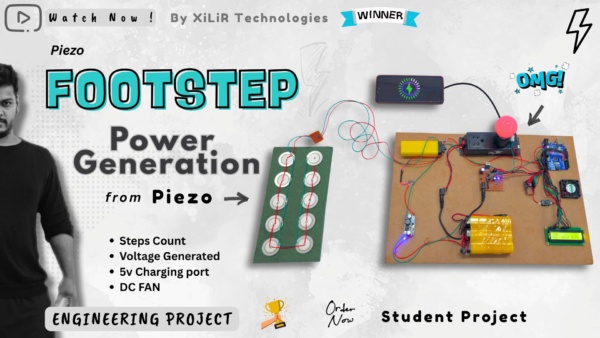
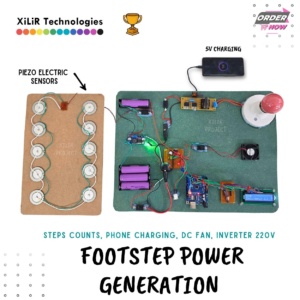
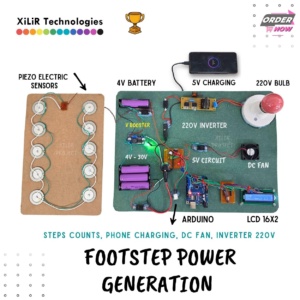
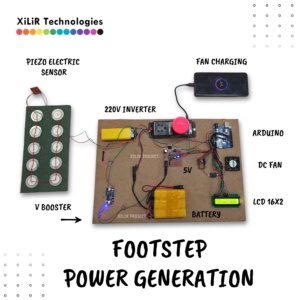
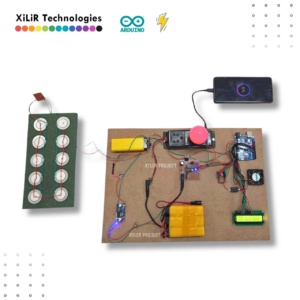
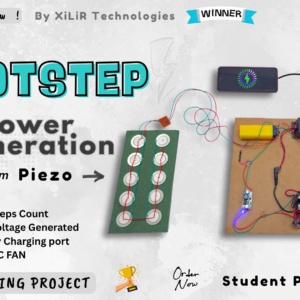
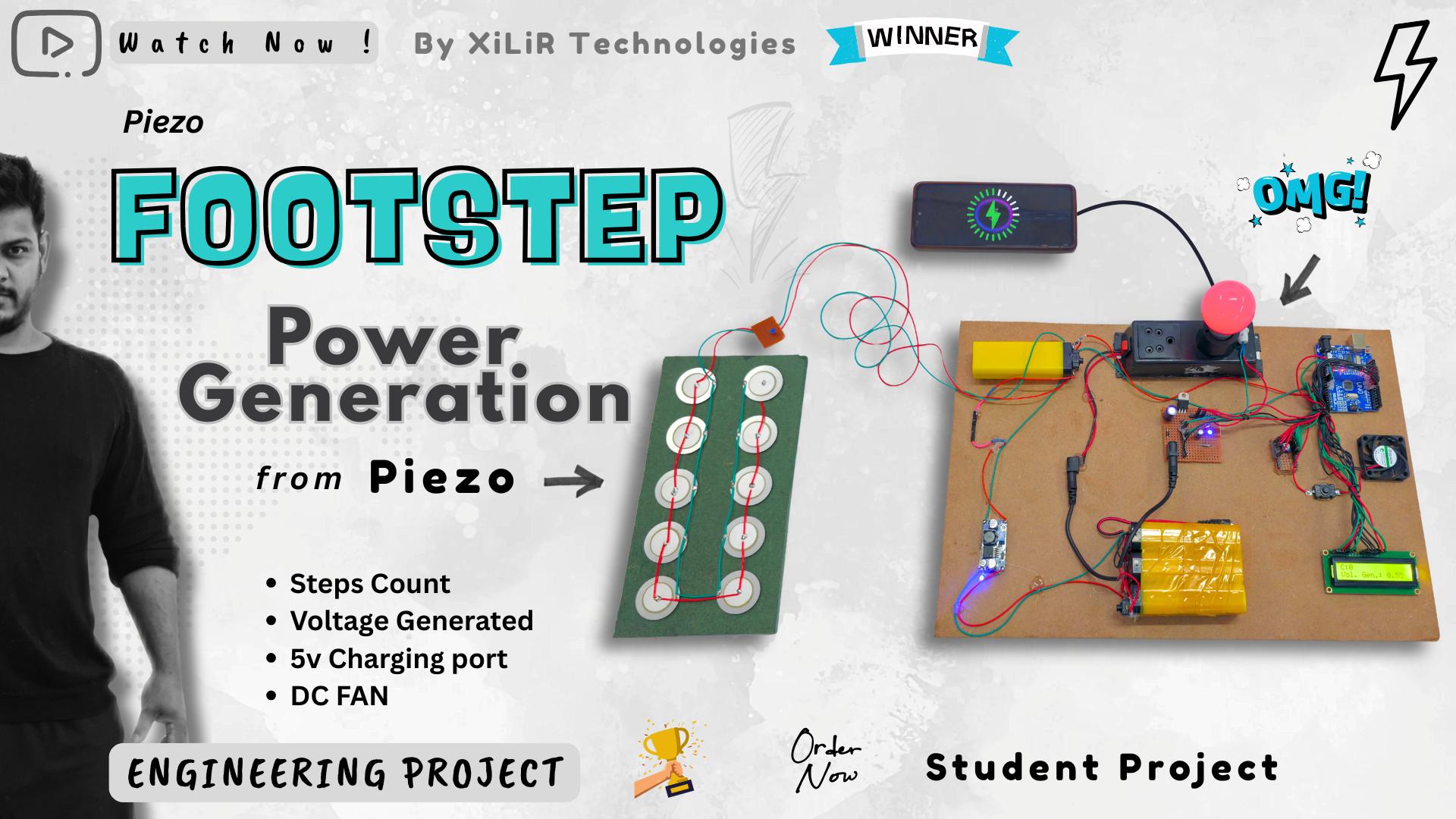
This Arduino-based Foot Step Power Generation System converts walking energy into electricity using piezoelectric sensors. It can charge mobile phones, power DC fans, and operate a 220V inverter. The setup also includes a step counter display, making it an ideal demonstration of renewable energy and sustainable technology for students and exhibitions.
⚡ Renewable energy generation from footsteps
🔋 Battery storage with voltage boosting system
📱 Mobile charging support
📟 Real-time step counting with LCD display
📊 Practical, educational, and eco-friendly solution
📺 YouTube Video : Watch Now
#FootstepEnergyGeneration #PiezoelectricSensor #EnergyHarvesting
#RenewableEnergy #GreenEnergy #SustainablePower
#FinalYearProjects #BTechProjects #MTechProjects
#CapstoneProjects#SmartInfrastructure #CleanEnergy
📘 Introduction
As the world heads in the direction of clean and renewable energy, the demand for sustainable power generation technologies is higher than ever. Human movements, particularly walking, let loose a huge amount of waste mechanical energy on a daily basis. Consider bus stops, airports, shopping malls, and railway stations where thousands of individuals walk every day—their footsteps can be harnessed as an assured supply of green power.
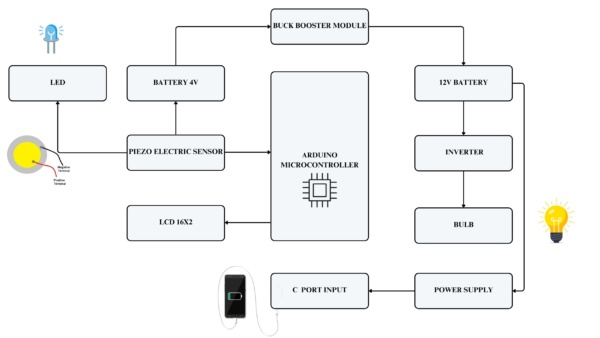
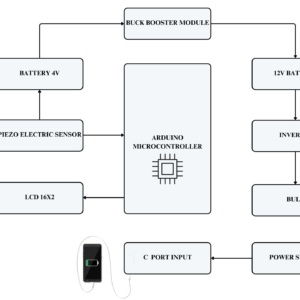
This project demonstrates an Arduino Footstep Power Generation System with Piezoelectric Sensors, in which mechanical stress by footsteps is transformed into electrical energy for practical use. The system consists of piezoelectric modules, batteries, buck-boost converter, inverter, and Arduino to produce, store, and convert energy for practical use. Footstep energy is stored in a 4V battery, increased to 15V with a buck-boost converter, utilized to charge a 12V battery, and then transformed into 220V AC for powering domestic loads like bulbs.
An Arduino UNO tracks footstep counting, shows real-time data on an LCD display, and even offers mobile phone charging via C-type port, making the system feasible for public areas. The pioneering project proves how piezoelectric energy harvesting can be used in sustainable power solutions, smart cities, and green infrastructure.
🎯 Objectives
📊 Block Diagram
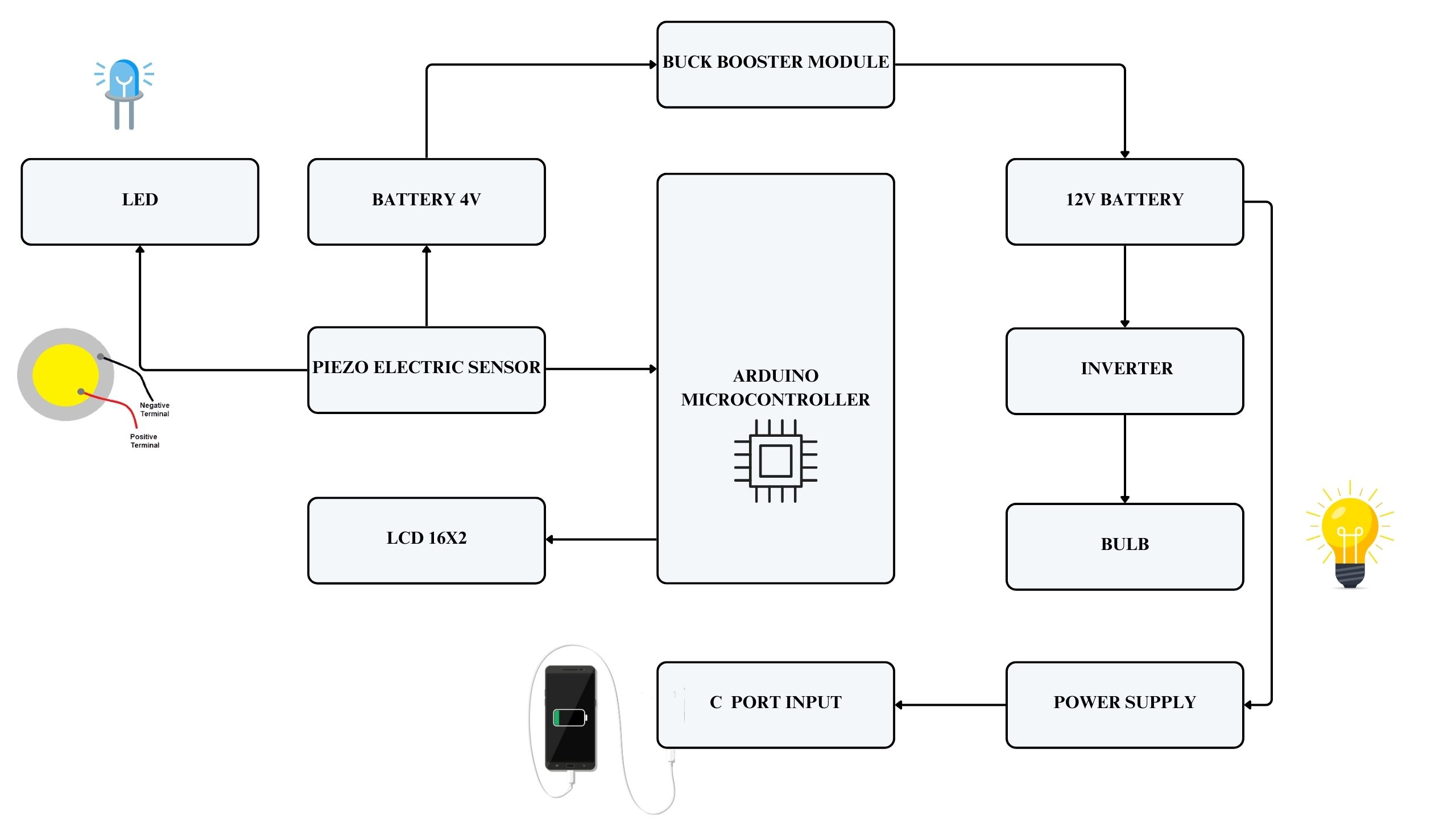
Block Diagram : Footstep Power Generation using Piezoelectric Sensors & Arduino
🔁 System Overview
🛠️ Components
⚙️ Methodology
The system is based on piezoelectricity, in which piezoelectric modules produce a voltage when subjected to mechanical stress. There are several Piezo Sensors embedded within the walking platform such that each footstep generates tiny bits of electricity. The outputs are parallel connected, rectified, and charged into a 4V rechargeable battery protected by diodes so that reverse current flow is not allowed. As 4V is not enough for real application, a buck-boost converter boosts the voltage to 15V, which is utilized to charge a 12V battery to achieve greater energy capacity. The stored DC power is supplied to a DC-to-AC inverter, which converts it to 220V AC to power a bulb or small appliances. A manual switch is provided for on-demand operation. An Arduino UNO tracks footsteps by sensing pressure signals from the sensors, logging them in the form of pulses, and showing step count and voltage on a 16×2 LCD Display . Apart from driving an AC bulb, the system also provides a mobile phone charging facility through a regulated C-port, hence making it feasible for public areas. This approach shows how easy it is to harvest pressure from simple footsteps, store it, and turn it into functional electricity, providing a sustainable and environmentally friendly energy source for smart cities, transport stations, and green infrastructure.
Piezoelectric Sensor – Theory, Working, History and Equations
A piezoelectric sensor is a device that converts mechanical energy such as pressure, force, or vibration into electrical energy using the piezoelectric effect. This effect is observed in certain materials like quartz, ceramics, and some polymers. When these materials are subjected to mechanical stress, they generate an electric charge across their surfaces. Similarly, when an electric field is applied, they can also produce mechanical deformation, making them useful in both sensing and actuation applications.
History
The piezoelectric effect was discovered in 1880 by two French scientists, Jacques Curie and Pierre Curie. They found that certain crystals generate electrical charge when mechanical pressure is applied. Later, the reverse piezoelectric effect was also discovered, where applying voltage causes the material to deform. Over time, this principle has been widely used in sensors, actuators, medical devices, and energy harvesting systems.
Materials Used in Piezoelectric Sensors
Piezoelectric effect occurs only in specific materials. Commonly used materials include:
Among these, PZT (Lead Zirconate Titanate) is most commonly used due to its high efficiency and strong piezoelectric effect.
🔌 Output Voltage (Observed)
| Condition | Voltage Output |
|---|---|
| Single Tap | 3V – 8V (pulse) |
| Continuous Steps | 8V – 15V |
| After Booster | 12V – 17V |
⚡ Current Output (Improved Practical Range)
| Condition | Current |
|---|---|
| Single Tap | 5µA – 20µA |
| Continuous Steps | 50µA – 200µA |
| With Storage Capacitor | 0.5mA – 2mA (short bursts) |
Ipractical≈1mA (peak with capacitor)
🔋 Battery Charging (Realistic Statement)
Realistic full charging, write:
3.7V battery increased to 3.8V in 60 minutes (continuous tapping)
⚡Power Calculation
P=V×I
P=12×0.001=0.012W
“The system efficiency can be further improved by using multilayer piezo stacks, mechanical amplifiers, and high-efficiency boost converters.”
Working Principle:
This system works on the piezoelectric effect, where mechanical pressure from footsteps is converted into electrical energy. When a person steps on the piezoelectric sensors, force is applied, generating electrical charge and voltage.
The generated charge is:
Q = d × F
The generated voltage is:
V = Q / C
In this project, 10 piezo sensors are connected in parallel to increase current output:
I_total = I1 + I2 + … + I10
When footsteps are applied, the sensors produce voltage pulses which are used to glow a bulb instantly. The output is passed through a diode to charge a 3.7V battery. A voltage booster increases the voltage to around 17V to charge a 12V battery, and an inverter converts it into 220V AC for powering a bulb.
Applications: Piezoelectric sensors are used in a variety of applications, including:
💡 Title Suggestions
Tags
footstep energy generation, piezoelectric sensor project, energy harvesting from footsteps, piezoelectric generator, renewable energy from footsteps, piezoelectric energy harvesting, footstep electricity generation, walking energy conversion, piezoelectric footstep technology, self-powered shoes, human motion energy harvesting, footstep energy capture, piezo power generation, sustainable energy from footsteps, piezoelectric walkway project, footstep energy utilization, footstep electricity production, piezoelectric floor mat, smart pavement energy system, IoT footstep energy project, engineering final year project, capstone project on renewable energy, science exhibition renewable project
🔹 🔹 🔹 🔹 🔹 🔹 🔹 🔹 🔹 🔹
🔖 What’s Included with your Foot Step Power Generation Project ?
💯 Fully Working & Assembled Project
📘 Docs – Includes synopsis, PPT, report & diagrams
🔄 Circuit & Block Diagrams – Clear and labelled
💻 Arduino Code + Training – Upload & customize easily
⚙️ Working Principle Explained
📦 Component Specs + BOM
📑 Datasheets Provided – For sensors and modules
🔌 Complete Wiring Guide
🎓 Viva Q&A Help – With expert support via WhatsApp
🙌 Need custom features or upgrades? Just ask — we’re happy to help! 🙌
🚚 Delivery & Payment
✔ Cash on Delivery Available (India Only)
✔ Safest, Secure & Trackable delivery across Globally.
⭐ Trusted by 20,50,000+ Students, Teachers & Innovators
🏆 Serving the academic & research community since 2012
🔹 🔹 🔹 🔹 🔹 🔹 🔹 🔹 🔹 🔹
📞 To Buy/ Make this project with training
Contact us:
👨🏼🏭 Dr. Vipin Kumar Sharma
🎓 Ph.D., M.Tech, B.Tech (ECE), C.E, D.E NS.
👨🏫 Lecturer | 🚀 Researcher | 🤖 Robotics | 🌐 IoT
✅🔥Follow us on
📺 YouTube 👥 Facebook 🐤 Twitter 📸 Instagram👨🏻🎓 LinkedIn
• • • • • • • • • • • • • • • • • • • • • • •
📍𝗔𝗯𝗼𝘂𝘁 𝗨𝘀 :
𝗫𝗶𝗟𝗶𝗥 𝗧𝗲𝗰𝗵𝗻𝗼𝗹𝗼𝗴𝗶𝗲𝘀™ is India’s 🔖Top Rated & Leading Research & Development Company. It’s an ISO 9001:2008 Certified Company & Govt Approved under MCA & it was established in 2012.
• • • • • • • • • • • • • • • • • • • • • • •
Students can enhance or modify this project based on college syllabus, guide instructions, or personal interest.
Customizations help improve innovation, marks, and practical understanding.
Available Customization Options:
🌐 IoT/ AI/ ML Integration ( ThingSpeak, Blynk, Firebase, Web Dashboard etc. )
☀️ Solar Power Integration
🤖 Machine Learning / AI Modules
📡 GPS & GSM Based Tracking / Alerts
📟 Additional Sensors (as per application)
📲 Mobile App / Web Monitoring
📊 Advanced Data Logging & Graphs
⚙️ Hardware & Software Feature Modifications
🎯 Customization as per College or Guide Requirement
If you need any additional feature or modification,
📞 Contact us on WhatsApp and share your requirement.

Early Project Booking Recommended
Early Project Booking – Strongly Recommended
Students are advised to book their final year or semester project early, even with just a title or brief idea. Early booking helps us reserve your preferred topic, start documentation, diagrams, code planning, and component preparation in advance, and provide timely academic guidance.
You will receive complete documentation (abstract, report, block diagram, circuit, code explanation) well before submission. The working hardware kit will be delivered as per your college schedule. PPTs for reviews, viva, or seminars will be prepared on request.
Book early → Stay stress-free → Focus on learning.
Contact us with just the project title—we’ll handle the rest.
No branding, handmade and different look as required by students.
WhatsApp : https://wa.me/919810326343
————————————
🔖 What you’ll get when you order this Project !
💯 Fully Assembled & Working Project.
🛠️ The project can be disassembled and reassembled if needed, making it easier to show progress-wise demonstrations to your guide.
📘 Includes Synopsis, Report, PPT & more.
📊 Block Diagram & Circuit Diagram – With explanations.
📦 Component Specs List.
⚙️ Working Principle Explained.
📑 Datasheets of All Components.
💻 Arduino Code + Training.
🧾 Bill of Materials (BOM) – Every item listed.
🔌 Complete Interfacing Guide – Learn how each part is connected.
🚚 Cash on Delivery Available – Safe & Secure delivery.
🎓 Viva Q&A Guidance – Be 100% ready for your Viva.
❓Need anything, Just ask us – we’re here to help! 🙌
————————————
🥇 Trusted by 20,50,000+ Students / Teachers & Innovators.
Additional Services you can buy :
Research paper, Review paper,
Plagiarism free Report with Turnitin report,
internship, industrial training/ project etc.







Reviews
There are no reviews yet.