
Original price was: ₹12,500.00.₹7,350.00Current price is: ₹7,350.00.
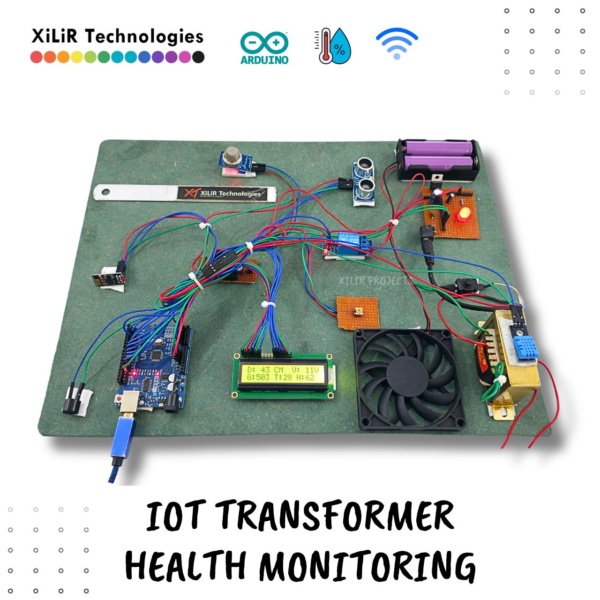
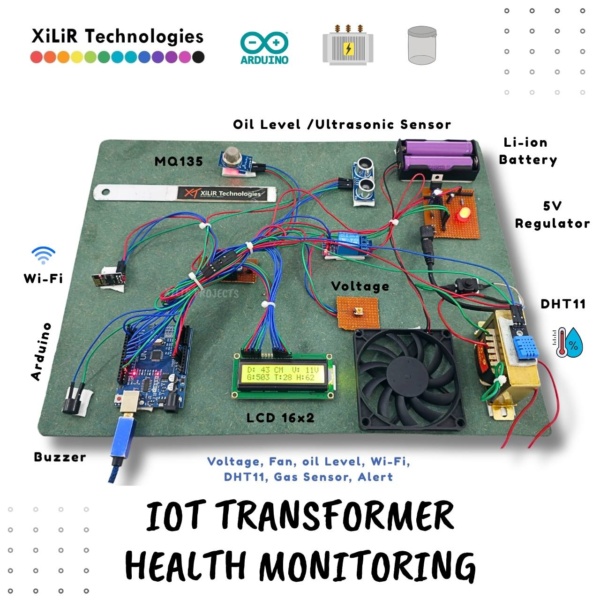
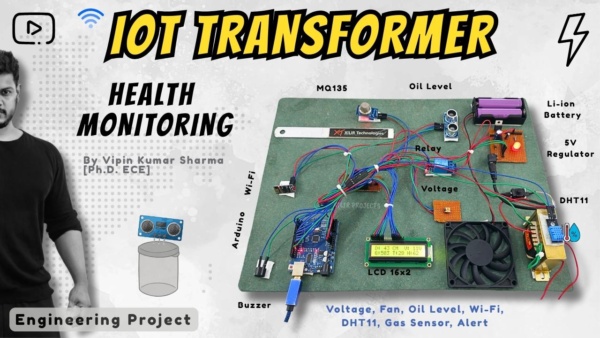
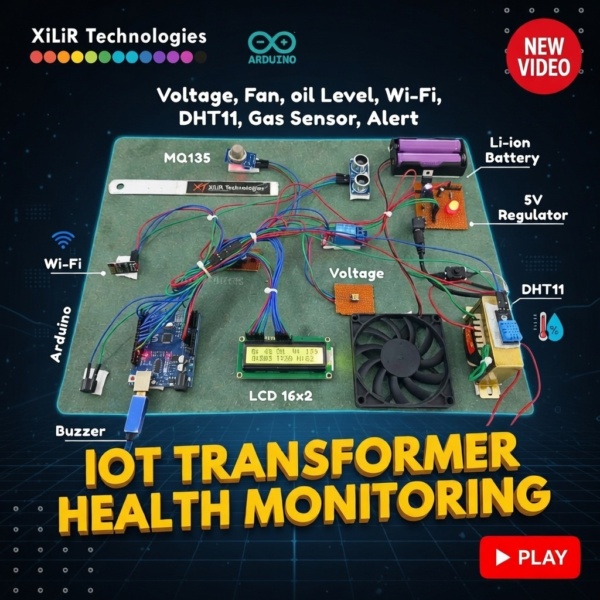
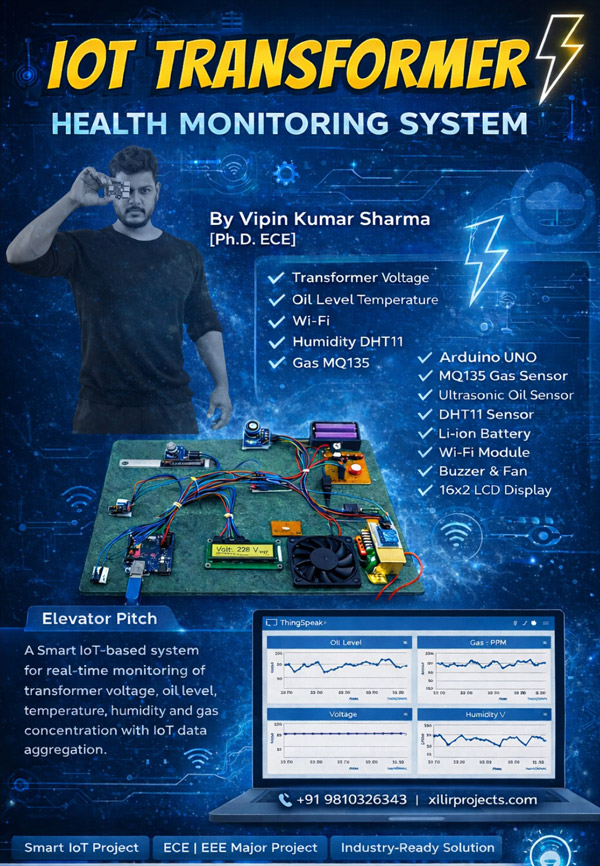
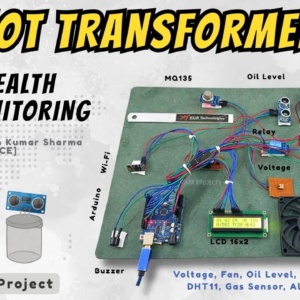
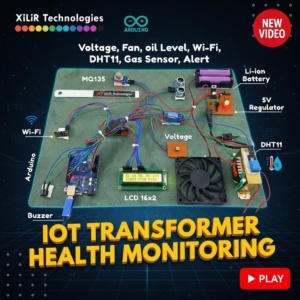
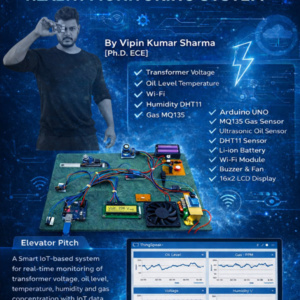
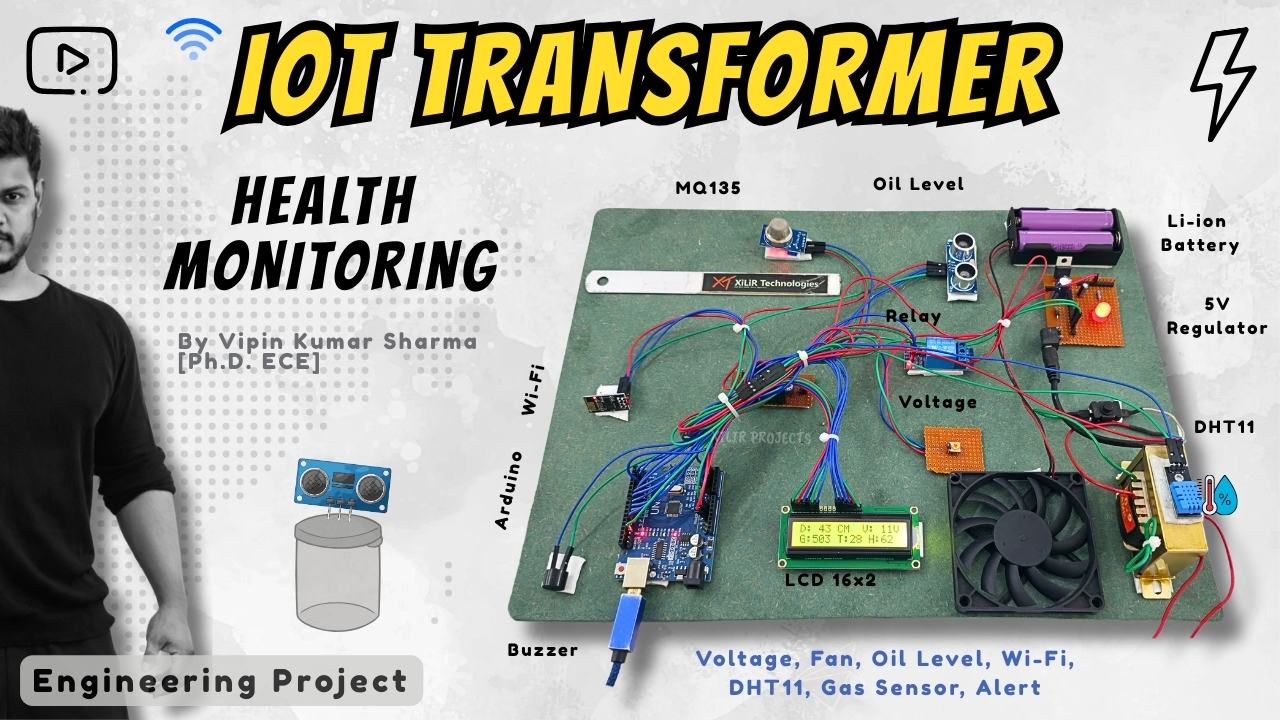
IOT & AI Based Transformer Health Monitoring System that monitors transformer health in real time, predicts possible failures , and prevents costly breakdowns.
—If values exceed safe limits → Transformer Risk
—If values show abnormal trend growth → AI Predicted Fault
—If values are normal → Transformer Safe ✅
Highlights
⚡ Real-time voltage and load monitoring
🌫️ Gas detection for insulation Burning
🌡️ Temperature & humidity
📡 ThingSpeak IoT cloud dashboard with live graphs
🤖 AI-based predictive fault analysis
🌀 Automatic Buzzer Alert + Relay DC Fan Cooling
📊 Predictive maintenance and early fault detection
📺 YouTube Video: Full Project Demonstration
🎥 Project Short: Quick Overview
🔁 Advanced Version: Machine Learning-Based Transformer Fault Classification
A smart IoT & AI system that monitors transformer health in real time ⚡, predicts possible failures 🤖, and prevents costly breakdowns 🔥.
—If values exceed safe limits → ❌ Transformer Risk
—If values show abnormal trend growth → ⚠️ AI Predicted Fault
—If values are normal → ✅ Transformer Safe
Highly Recommended for Major Project, Capstone, Research, Industry 4.0 Exhibition, or Smart Grid Applications.
📘 Introduction
Power transformers are the backbone of electrical distribution networks, stepping up/down voltages for efficient transmission and safe delivery to industries, cities, and homes. However, failures from overheating, insulation breakdown, overload, moisture ingress, or dissolved gases lead to massive outages, economic losses, safety hazards, and even catastrophic events like fires or explosions.
Key Facts & Statistics
History of Transformer Monitoring Early 20th century relied on periodic manual inspections and scheduled downtime. By the 1950s–1970s, basic instrumentation and offline tests (e.g., oil sampling) emerged. The 1970s introduced basic online monitoring for temperature/voltage. Traditional methods like periodic Dissolved Gas Analysis (DGA) and visual checks remain expensive, offline, and miss incipient faults. The shift to IoT (real-time sensors + cloud) in recent decades, combined with AI for trend prediction, enables continuous, proactive monitoring — transforming reactive maintenance into predictive strategies.
Why Industrial Automation is Needed in Power Systems Industrial automation enhances efficiency, reliability, safety, and cost control in power systems. For transformers, it enables real-time data collection, automated alerts/actuation (e.g., cooling fans), reduced human error, minimized downtime, energy optimization, and predictive maintenance. In smart grids, automation supports load balancing, fault isolation, and integration of renewables — critical for modern power infrastructure facing aging assets, rising demand, and extreme weather.
The system utilizes various sensors to continuously monitor critical parameters such as temperature, oil level, and vibrations, ensuring early detection of potential faults or abnormalities. Collected data is securely transmitted and stored on a web server, facilitating remote access and analysis by maintenance personnel. Through advanced data analytics and machine learning algorithms, the platform can predict impending issues and generate timely maintenance alerts, reducing downtime, optimizing maintenance schedules, and prolonging the lifespan of transformers. The project aims to enhance the reliability and efficiency of power distribution systems by leveraging web-based monitoring technologies for proactive transformer health management
Power transformers are essential components in electrical distribution networks. Failures due to overheating, gas formation, voltage instability, and environmental stress can cause severe economic loss and power outages.
Traditional monitoring methods rely on periodic inspection and manual testing, which cannot detect real-time developing faults.
This project introduces an AI & IoT-based Transformer Health Monitoring System that integrates multiple sensors with cloud-based data analytics. Sensor readings are uploaded to ThingSpeak, where historical data is stored and analysed.
An AI-based algorithm evaluates:
Sudden voltage deviations
Increasing gas concentration trends
Rising humidity patterns
Repeated threshold violations
Using trend analysis and anomaly detection, the AI model predicts possible transformer faults before catastrophic failure occurs.
Objectives
BLOCK DIAGRAM
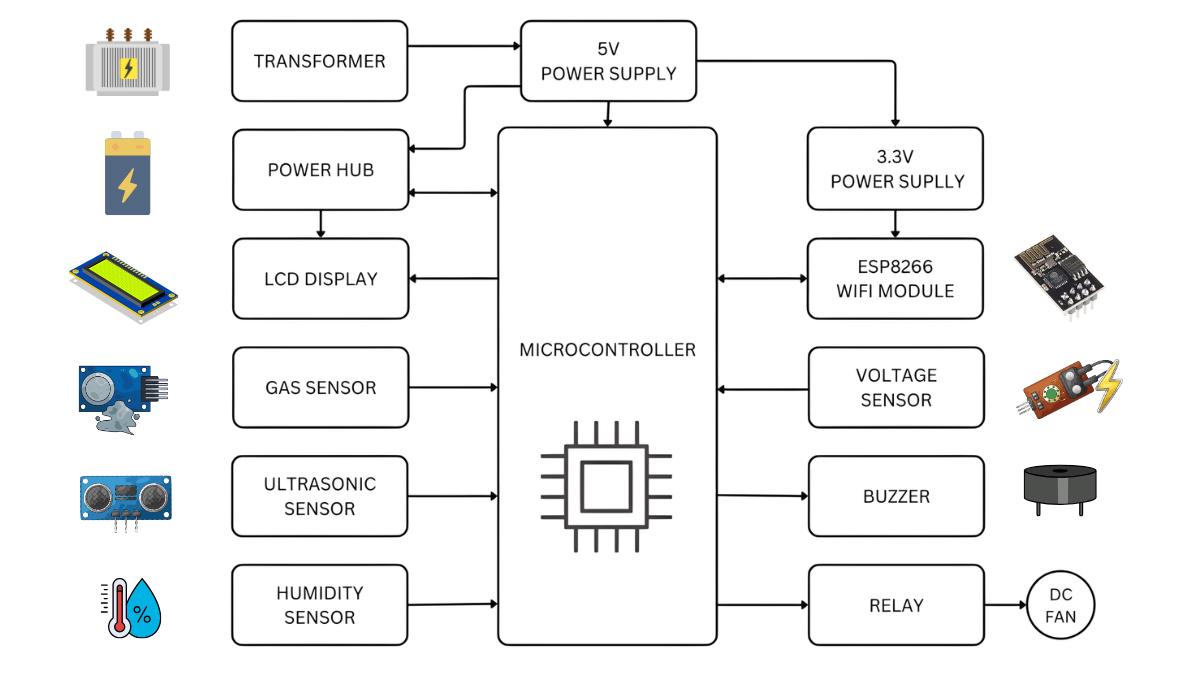
BLOCK DIAGRAM of IOT & AI Based Transformer Health Monitoring System
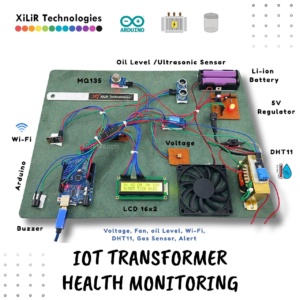
🧩 HARDWARE COMPONENTS
SOFTWARE
🧠 AI Integration (Core Intelligence Layer)
The AI system performs:
AI logic can be implemented using:
The system shifts from simple monitoring → to predictive transformer intelligence.
Methodology
The microcontroller reads:
Data displays on LCD (e.g., pins 7-12). Threshold breaches trigger buzzer and relay (fan ON for cooling). ESP8266 (software serial) uses AT commands to connect Wi-Fi and push multi-field data to ThingSpeak channels (e.g., fields: temp °C, humidity %, gas ppm, voltage V, current A, oil level cm). ThingSpeak provides live charts, MATLAB analysis for trends/AI rules (e.g., if temp rises >5°C/min → predictive alert), and integrations for notifications.
Power regulated to 5V (main) and 3.3V (ESP8266).
Theory of Operation
Titles Suggestion for Topic
========================
👉🚀 Don’t forget to SUBSCRIBE for more Science/ Diploma/ Engineering Projects !
========================
🔖 What’s Included with your Project ?
💯 Fully Working & Assembled Project
📘 Docs – Includes synopsis, PPT, report & diagrams
🔄 Circuit & Block Diagrams – Clear and labelled
💻 Arduino Code + Training – Upload & customize easily
⚙️ Working Principle Explained
📦 Component Specs + BOM
📑 Datasheets Provided – For sensors and modules
🔌 Complete Wiring Guide
🎓 Viva Q&A Help – With expert support via WhatsApp
🙌 Need custom features or upgrades? Just ask — we’re happy to help! 🙌
🚚 Delivery & Payment
✔ Cash on Delivery Available (India Only)
✔ Safest, Secure & Trackable delivery across Globally.
⭐ Trusted by 20,50,000+ Students, Teachers & Innovators
🏆 Serving the academic & research community since 2012
📞 To Buy/ Make this project with training
• • • • • • • • • • • • • • • • • • • • • • •
Contact us:
👨🏼🏭 Dr. Vipin Kumar Sharma
🎓 Ph.D., M.Tech, B.Tech (ECE), C.E, D.E NS.
👨🏫 Lecturer | 🚀 Researcher | 🤖 Robotics | 🌐 IoT
📱 WhatsApp (Direct Support) Hindi/ English Language
• • • • • • • • • • • • • • • • • • • • • • •
🔥Hi Guys, Follow us on
📺 YouTube 👥 Facebook 🐤 Twitter 📸 Instagram👨🏻🎓 LinkedIn
• • • • • • • • • • • • • • • • • • • • • • •
Students can enhance or modify this project based on college syllabus, guide instructions, or personal interest.
Customizations help improve innovation, marks, and practical understanding.
Available Customization Options:
🌐 IoT/ AI/ ML Integration ( ThingSpeak, Blynk, Firebase, Web Dashboard etc. )
☀️ Solar Power Integration
🤖 Machine Learning / AI Modules
📡 GPS & GSM Based Tracking / Alerts
📟 Additional Sensors (as per application)
📲 Mobile App / Web Monitoring
📊 Advanced Data Logging & Graphs
⚙️ Hardware & Software Feature Modifications
🎯 Customization as per College or Guide Requirement
If you need any additional feature or modification,
📞 Contact us on WhatsApp and share your requirement.
Early Project Booking Recommended
Early Project Booking – Strongly Recommended
Students are advised to book their final year or semester project early, even with just a title or brief idea. Early booking helps us reserve your preferred topic, start documentation, diagrams, code planning, and component preparation in advance, and provide timely academic guidance.
You will receive complete documentation (abstract, report, block diagram, circuit, code explanation) well before submission. The working hardware kit will be delivered as per your college schedule. PPTs for reviews, viva, or seminars will be prepared on request.
Book early → Stay stress-free → Focus on learning.
Contact us with just the project title—we’ll handle the rest.
FAQs