

Original price was: ₹12,000.00.₹8,150.00Current price is: ₹8,150.00.
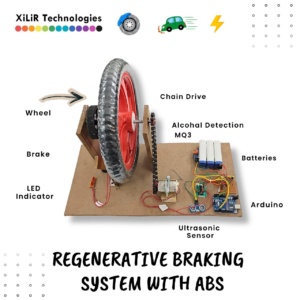
The advanced regenerative braking system is a significant advancement in energy conservation and efficiency for vehicles. This technology captures and repurposes kinetic energy during braking, resulting in lower emissions, better fuel economy, and a more enjoyable driving experience.
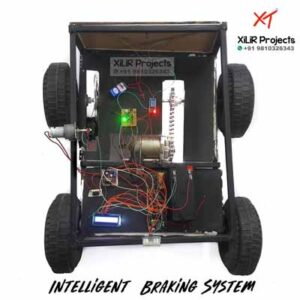
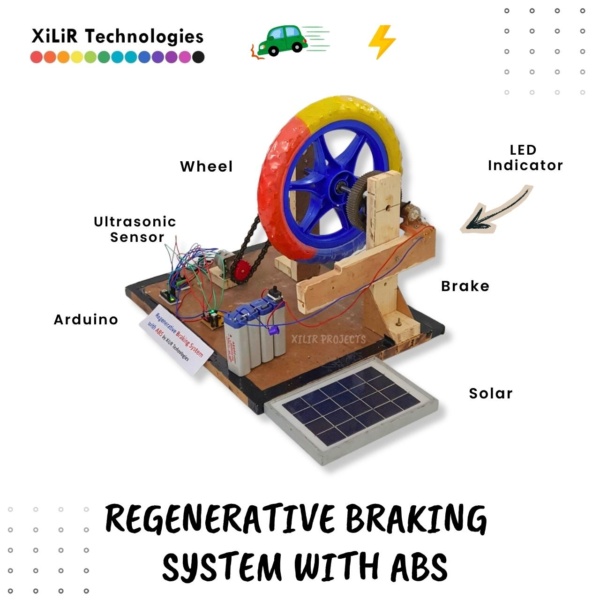
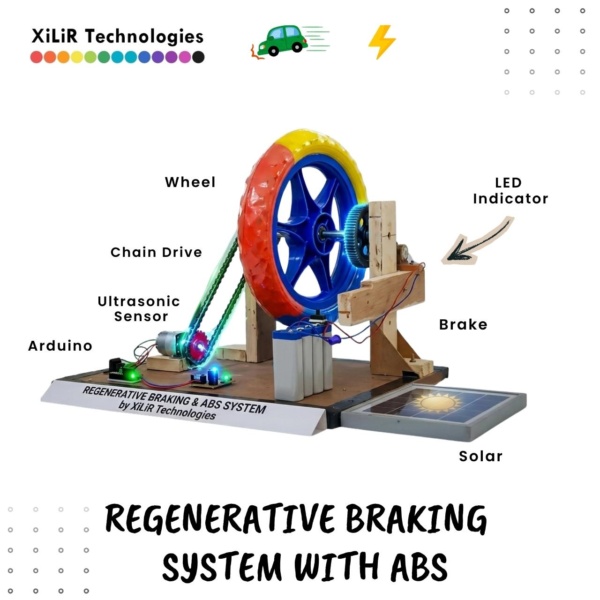
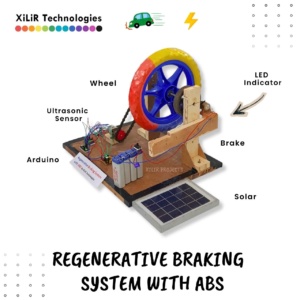
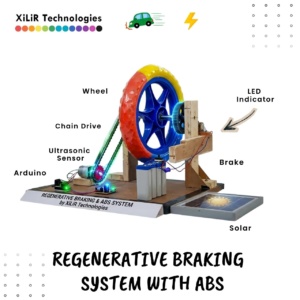
If the vehicle detects an obstacle within 30 cm, the system reduces the motor speed to slow down the vehicle. If the distance further decreases to 10 cm, the system activates an ABS-like controlled braking mechanism to safely stop the wheel while enabling regenerative energy recovery.
📺 YouTube Video : Watch Now
📺 YouTube Video Version 2: Watch Short
Watch Short with Alcohal Sensor
This is an award-winning project concept that can be selected for a major project, capstone project, exhibition, or engineering competition project.
If the vehicle detects an obstacle within 30 cm, the system reduces the motor speed to slow down the vehicle. If the distance further decreases to 10 cm, the system activates an ABS-like controlled braking mechanism to safely stop the wheel while enabling regenerative energy recovery.
INTRODUCTION
Transportation systems have experienced significant technological evolution over the past 150 years, transitioning from steam-powered engines in the 1800s to internal combustion engine vehicles in the 20th century, and more recently to electric and hybrid mobility solutions in the 21st century. One of the major technological innovations supporting modern electric vehicles is the regenerative braking system, which improves vehicle energy efficiency by recovering energy during braking. In conventional braking systems, nearly 100% of the vehicle’s kinetic energy is dissipated as heat through friction between brake pads and wheels. This loss of energy not only reduces efficiency but also contributes to increased fuel consumption and component wear. Regenerative braking systems address this limitation by converting a portion of the vehicle’s kinetic energy into electrical energy during deceleration, allowing it to be stored in a battery and reused later.
The concept of regenerative braking was first introduced in 1886 in early electric railway systems. Electric locomotives and tram systems used regenerative braking motors to feed electrical energy back into the power grid during braking. One of the earliest practical applications was implemented in electric rail transport systems in 1930, where braking motors were used as generators to recover energy. With advancements in electric motor design, power electronics, and battery storage technologies, regenerative braking became more practical and began appearing in modern vehicles. The first commercial hybrid vehicle integrating regenerative braking technology was the Toyota Prius introduced in 1997, which demonstrated significant improvements in fuel efficiency and energy recovery.
Energy efficiency has become a critical concern in modern transportation systems. According to the International Energy Agency (IEA), the transportation sector contributes approximately 24% of global carbon dioxide emissions from fuel combustion. Road vehicles alone account for nearly 75% of transportation-related emissions. Due to these environmental concerns, electric vehicles are increasingly being adopted worldwide. Global electric vehicle sales exceeded 14 million units in 2023, representing approximately 18% of total global car sales, compared to less than 1% in 2015. These statistics highlight the growing need for technologies that enhance electric vehicle efficiency and extend battery life.
Regenerative braking plays a significant role in improving the performance of electric vehicles. Research studies show that regenerative braking systems can recover between 10% and 30% of the kinetic energy that would normally be lost during braking. In urban driving conditions, where frequent stopping occurs, energy recovery can increase to nearly 35%, significantly improving vehicle efficiency. For example, electric vehicles equipped with regenerative braking can extend driving range by approximately 15% to 25%, depending on driving patterns and traffic conditions.
From a technical perspective, regenerative braking operates based on the principle of electromagnetic induction, first discovered by Michael Faraday in 1831. When the vehicle decelerates, the electric motor connected to the wheels operates in generator mode. The rotational motion of the wheels drives the motor shaft, inducing electrical voltage in the motor windings. The generated electrical power is then transferred back to the battery through power electronics circuits. This process allows the system to capture otherwise wasted kinetic energy and convert it into usable electrical energy.
In modern intelligent transportation systems, regenerative braking is often integrated with microcontroller-based control systems and sensor technologies. Sensors such as ultrasonic sensors, wheel speed sensors, and distance monitoring modules provide real-time data regarding vehicle motion and surrounding obstacles. Microcontrollers process this data and control motor driver circuits to regulate braking intensity and energy recovery. These smart control mechanisms improve both vehicle safety and energy efficiency, making regenerative braking an important component of modern electric mobility.
The increasing demand for smart vehicles, autonomous driving technologies, and sustainable transportation systems has further increased the importance of advanced braking technologies. Intelligent braking systems combined with sensor-based detection can automatically respond to obstacles and reduce collision risks. At the same time, regenerative braking ensures that the kinetic energy generated during vehicle motion is effectively utilized instead of being wasted as heat.
OBJECTIVES
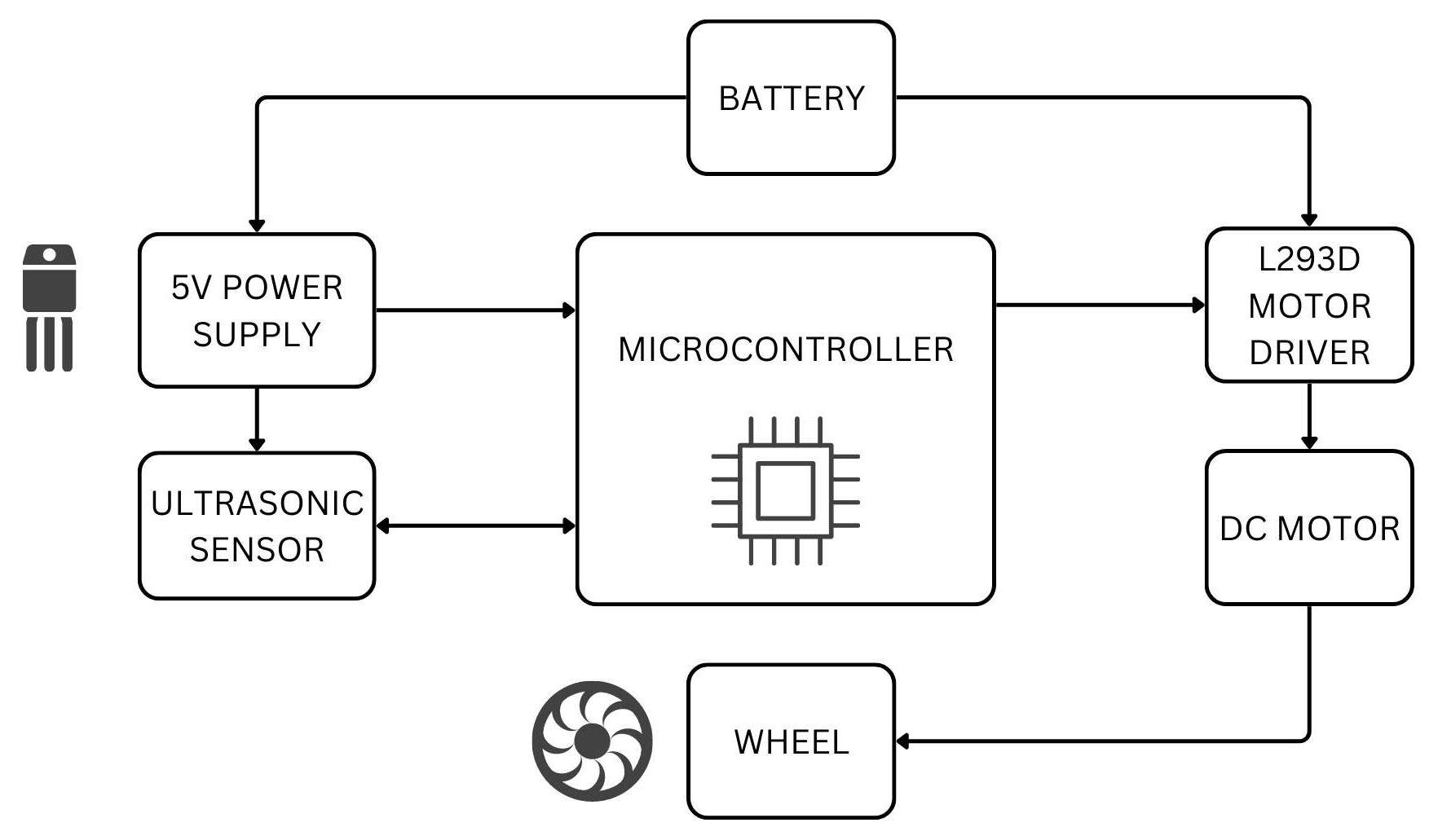
BLOCK DIAGRAM
COMPONENTS
SOFTWARE
ARDUINO IDE
WORKING PRINCIPLE
The Advanced Regenerative Braking System operates using a microcontroller-based control mechanism integrated with sensing, braking, and energy recovery units. In this project, the battery and solar panel provide the required input power to the circuit through a regulated 5 V supply, which is used to operate the Arduino microcontroller, ultrasonic sensor, and control section. The ultrasonic sensor continuously measures the distance between the moving wheel setup and any obstacle placed in front of it. When the detected distance becomes less than the predefined limit, the Arduino sends a control signal to the motor driver so that braking action can be applied.
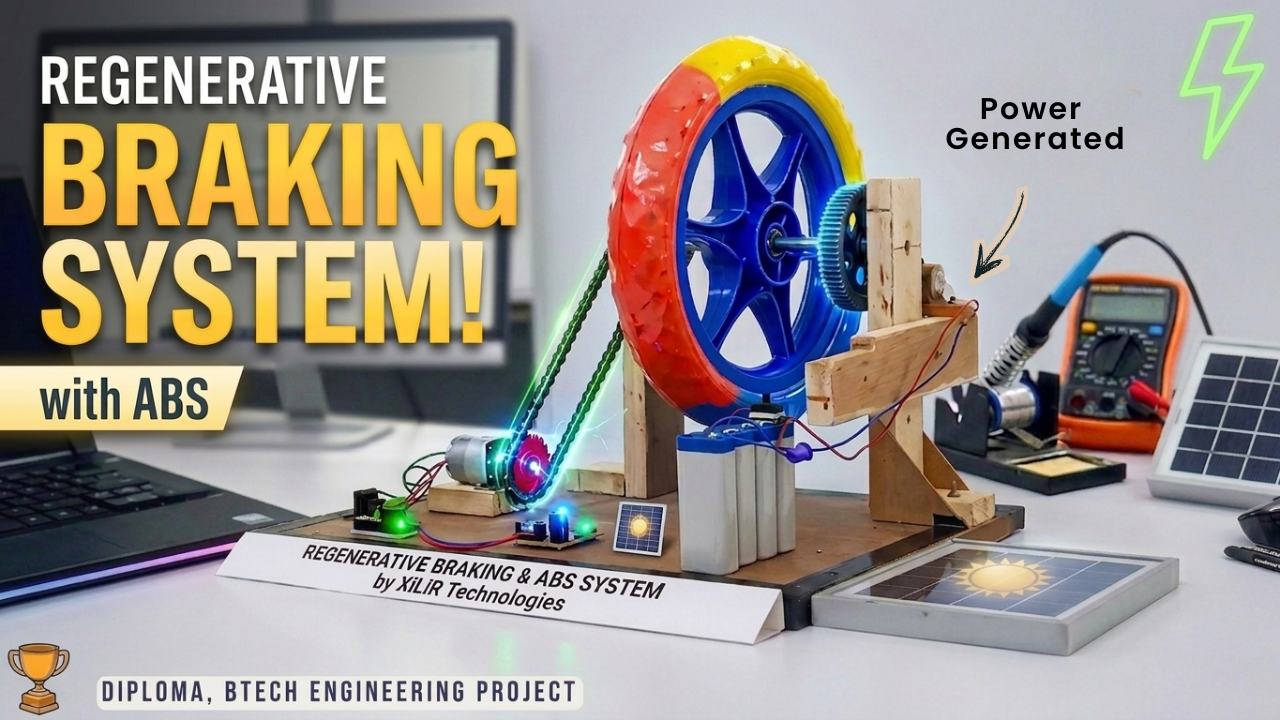
During normal running conditions, the motor rotates the wheel continuously. When braking is applied, the rotating mechanism is coupled to the stepper motor used as a generating element. At the time of deceleration, the kinetic energy of the rotating wheel is not completely wasted as heat, but a portion of it is converted into electrical energy by the stepper motor. This represents the fundamental concept of regenerative braking, where mechanical energy is converted into electrical energy during braking.
The kinetic energy available in the rotating system can be expressed as:
KE = (1/2) × m × v²
where
m = mass of the moving body
v = velocity of the wheel
During braking, part of this kinetic energy is converted into electrical energy and supplied to the output section.
The electrical power generated by the system can be calculated using the equation:
P = V × I
where
V = generated voltage
I = generated current
For this project, the measured generated voltage is 6 V and the generated current is 40 mA.
40 mA = 0.04 A
Therefore,
P = 6 × 0.04
P = 0.24 W
Thus, the regenerative braking section generates approximately 0.24 W of electrical power during braking.
The electrical energy generated over a period of time can be calculated as:
E = P × t
where
P = generated power
t = time
If the braking-based generation continues for 10 seconds, then:
E = 0.24 × 10
E = 2.4 J
Therefore, the system can generate approximately 2.4 joules of electrical energy in 10 seconds of braking operation.
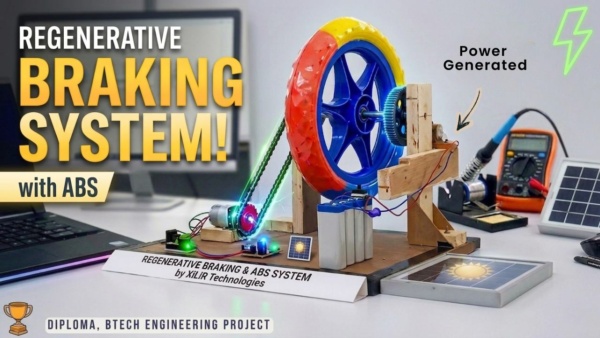
In the practical demonstration of the project, this generated electrical energy is sufficient to glow four LEDs simultaneously. The LED load confirms that the energy recovered during braking is usable electrical energy. When the stepper motor generates approximately 6 V and 40 mA, the recovered power is enough to illuminate four LEDs connected in the circuit.
The current relationship can also be expressed as:
I = Q / t
where
I = current
Q = electric charge
t = time
The voltage generation in the stepper motor is based on the principle of electromagnetic induction described by Faraday’s Law, which can be expressed as:
E = − N (dΦ / dt)
where
E = induced voltage
N = number of turns in the coil
dΦ/dt = rate of change of magnetic flux
When braking causes the rotor of the stepper motor to rotate, the changing magnetic flux induces voltage across the motor windings, generating electrical power.
Therefore, when braking is applied in this project, the rotating wheel drives the stepper motor in generator mode and produces approximately 6 V and 40 mA, resulting in an electrical power output of 0.24 W. This generated energy is used to power four LEDs, demonstrating that the regenerative braking mechanism successfully recovers part of the kinetic energy that would otherwise be lost during braking. This improves the overall energy efficiency of the vehicle system and demonstrates the practical application of regenerative braking technology.
Project Title Suggestions for Students
regenerative braking system project, regenerative braking using arduino, electric vehicle regenerative braking project, regenerative braking prototype, braking energy generation project, arduino regenerative braking system, EV braking technology project, energy recovery braking system, regenerative braking model for students, smart braking system project, electric vehicle project using arduino, regenerative braking demonstration model, renewable energy engineering project, braking electricity generation project, stepper motor generator project, EV energy recovery system, engineering project regenerative braking, final year engineering EV project, engineering students project ideas, school students science project, science exhibition renewable energy project, major projects for engineering students, engineering projects for CSE ECE EEE students, IoT based project ideas, EV technology project for students.
Advanced Regenerative Braking System using Arduino generating electricity during braking with stepper motor and LEDs demonstration. Electric vehicle energy recovery project model for engineering students. Buy complete project kit with free components, project report, documentation, synopsis, circuit diagram and Arduino code download for final year engineering projects.
Important
This regenerative braking system project is an excellent choice for engineering students, school students, and science enthusiasts who are looking for an innovative project in the field of electric vehicles and energy recovery technologies. The project demonstrates how kinetic energy produced during braking can be converted into useful electrical energy using a stepper motor generator and stored or used to power electrical loads such as LEDs. By combining concepts of renewable energy, smart braking systems, and microcontroller-based control using Arduino, the project provides a practical understanding of modern electric vehicle technologies.
Students working on BTech, MTech, diploma, and final year engineering projects can use this model to understand the working principle of regenerative braking used in electric vehicles such as Tesla, Toyota Prius, and other hybrid vehicles. The system also integrates sensors and motor drivers, allowing students to learn about embedded systems, energy recovery mechanisms, and smart vehicle safety systems. The project is highly suitable for major projects, capstone projects, technical exhibitions, and engineering competitions.
This project is particularly helpful for students in ECE, EEE, Mechanical, Mechatronics, Robotics, and Automotive engineering disciplines, as it combines concepts from electrical machines, renewable energy systems, and intelligent control systems. The prototype demonstrates real-time braking energy generation, producing approximately 6 V and 40 mA of electrical output, which is sufficient to glow multiple LEDs and verify the regenerative energy concept experimentally.
Students searching for electric vehicle projects, regenerative braking system projects, renewable energy engineering projects, Arduino based EV systems, and smart transportation project ideas will find this project highly educational and practical. It not only improves technical understanding but also helps students learn about sustainable transportation technologies that are shaping the future of mobility.
This project is widely recommended for engineering students, school students, science students, major projects, engineering projects for CSE, ECE, and EEE students, and IoT-based project ideas, making it a valuable learning platform for modern smart vehicle technology and energy-efficient systems.
🔹 🔹 🔹 🔹 🔹 🔹 🔹 🔹 🔹 🔹
Get the full working project with components, code, diagrams & explanation
No branding on project, handmade look for students, and different styles as required by students.
To Buy/ Make this project with training
Contact us:
👨🏼🏭𝗩𝗶𝗽𝗶𝗻 𝗞𝘂𝗺𝗮𝗿 𝗦𝗵𝗮𝗿𝗺𝗮
Ph.D., M.Tech, B.Tech in ECE
🎓Lecturer 🚀#Researcher #Drone #Robotics
WhatsApp : https://wa.me/919810326343
✅🔥Follow us on
▶️YouTube 👥 Facebook 🐤 Twitter 📸 Instagram👨🏻🎓 LinkedIn
𝗔𝗯𝗼𝘂𝘁 𝗨𝘀 :
𝗫𝗶𝗟𝗶𝗥 𝗧𝗲𝗰𝗵𝗻𝗼𝗹𝗼𝗴𝗶𝗲𝘀™ is India’s 🔖Top rated & Leading R&D Company. It’s an ISO 9001:2008 Certified Company & Govt Approved under MCA & it was established in 2012.
Students can enhance or modify this project based on college syllabus, guide instructions, or personal interest.
Customizations help improve innovation, marks, and practical understanding.
Available Customization Options:
🌐 IoT/ AI/ ML Integration ( ThingSpeak, Blynk, Firebase, Web Dashboard etc. )
☀️ Solar Power Integration
🤖 Machine Learning / AI Modules
📡 GPS & GSM Based Tracking / Alerts
📟 Additional Sensors (as per application)
📲 Mobile App / Web Monitoring
📊 Advanced Data Logging & Graphs
⚙️ Hardware & Software Feature Modifications
🎯 Customization as per College or Guide Requirement
If you need any additional feature or modification,
📞 Contact us on WhatsApp and share your requirement.

Early Project Booking Recommended
Early Project Booking – Strongly Recommended
Students are advised to book their final year or semester project early, even with just a title or brief idea. Early booking helps us reserve your preferred topic, start documentation, diagrams, code planning, and component preparation in advance, and provide timely academic guidance.
You will receive complete documentation (abstract, report, block diagram, circuit, code explanation) well before submission. The working hardware kit will be delivered as per your college schedule. PPTs for reviews, viva, or seminars will be prepared on request.
Book early → Stay stress-free → Focus on learning.
Contact us with just the project title—we’ll handle the rest.
No branding, handmade and different look as required by students.
WhatsApp : https://wa.me/919810326343
————————————
🔖 What you’ll get when you order this Project !
💯 Fully Assembled & Working Project.
🛠️ The project can be disassembled and reassembled if needed, making it easier to show progress-wise demonstrations to your guide.
📘 Includes Synopsis, Report, PPT & more.
📊 Block Diagram & Circuit Diagram – With explanations.
📦 Component Specs List.
⚙️ Working Principle Explained.
📑 Datasheets of All Components.
💻 Arduino Code + Training.
🧾 Bill of Materials (BOM) – Every item listed.
🔌 Complete Interfacing Guide – Learn how each part is connected.
🚚 Cash on Delivery Available – Safe & Secure delivery.
🎓 Viva Q&A Guidance – Be 100% ready for your Viva.
❓Need anything, Just ask us – we’re here to help! 🙌
————————————
🥇 Trusted by 20,50,000+ Students / Teachers & Innovators.
Additional Services you can buy :
Research paper, Review paper,
Plagiarism free Report with Turnitin report,
internship, industrial training/ project etc.
YouTube
FAQs